The face of social media, and technology as a whole, is changing, fast. Now don't get me wrong, i'm not anti-facebook at all, i'm on it right now. However, certain details have been catching my attention as of late. The facebook "clientele" i'm looking at now, hardly resembles those facebook users I was first aquainted with. A growing trend i've noticed throughout all social media, is how drastically the age range of users is changing. I remember when MySpace was the best we could do because FaceBook was restricted to college students, and then I remember the days when people were getting pissed off because high schoolers started signing-up. Now I didn't care that about any of that then, I was one of those high schoolers. However, when I sign in under that FB banner and look at the list of friends that pop up, I am often caught off-guard. I think I now understand why all those college kids were making such a big fuss over some high-school kid's friend-request. Its all our fault. We messed it up for everyone when we barged our way into a place where we didn't belong. It was by no means intentional, but we DID in fact open the "flood-gates" to the exceptions. Now, my 68 yr old father has facebook. He barely knows how to turn on the computer. All of you know the type of parent im talkin about. He's the kind who constantly alleges that the computer "deleted his emails," or refuses to even attempt to fix his own PC problems because he is 100% sure that he will break it, so he just calls you at 11pm asking why the printer's "broken?" and getting really upset when you don't know. But this man raised me in under his roof and provided for me, there's no possible way I can be justified in rejecting his friend-request. Right? However, do I necessarily want him to be able to read what my friends tell me I did the night before when I was drunk? The answer is no. So i'm forced to give him limited profile access, which i'm pretty sure only lets him see my picture. So whats the point? Why did he sign up? Unfortunately he did it for the same reason we did in the 9th or 10th grade. He did it because he can. Can't blame him for that, we did the exact same thing...but at what point do you have to draw the line? When is it just too weird? Example, my mom, who I guess has just recently discovered Twitter, is following Justin Timberlake. Not cool right? Yesterday I received a FB friend-request from my cousin, Austin. Problem.... he's thirteen years old. The worst part is, i'm sure he knows how to get around facebook wayy better than my parents, and there are just some things that are not appropriate for someone who hasn't even hit puberty. He's just old enough to read and understand what people write about and post pictures of, but he's not old enough to handle it. So here I am, feeling guilty that I rejected my little cousin, but really, I know that if it wasn't for us, and our impatience to get in the facebook clique, I wouldn't be in this situation in the first place. So keep this in mind, as we grow older, and new technologies evolve, we must make it our responsibility to know our place, to know where we belong, and to know where we have no business being at all.
-a.s.
Tuesday, December 8, 2009


Web 2.0 Summit
Every year for the past five years, there has been a web 2.0 conference held. The summit brings those in the internet industry together to look at how Web 2.0 is affecting their businesses and other endeavors. This year the theme was Websquared. The summit describes Websquared: "As we approach the six year mark from the original Web 2.0 thesis, the trends are becoming clearer than ever. Once applications live in the cloud, the key to success is harnessing network effects so that those applications literally get better the more people use them. But that's just the beginning. Today we see that applications are being driven by sensors, not just by people typing on keyboards. They are becoming platforms for collective action, not just collective intelligence."
We can see that we no longer just use the web, the web uses us to create content and generate action. Social networking is just the beginning. Facebook began as a fairly passive application in which one could view friends profiles, but it becomes increasingly more interactive and collaboration.
Google also began as merely a search engine, but has developed into email and so much more. It's latest development is GoogleWave, which I have to admit I haven't totally figured out yet. It seems to allow people to communicate, collaborate, and create documents in real time through cyberspace. Collaboration is key what will be next?
This is a long video taken from the summit called "What Do Teens Want?". It's interesting to see perspective from our age group at the summit. I don't expect you to watch the whole 30+ minutes, but you might find a few snippets interesting: http://www.youtube.com/watch?v=NLblEHTnLPQ&feature=player_embedded
We can see that we no longer just use the web, the web uses us to create content and generate action. Social networking is just the beginning. Facebook began as a fairly passive application in which one could view friends profiles, but it becomes increasingly more interactive and collaboration.
Google also began as merely a search engine, but has developed into email and so much more. It's latest development is GoogleWave, which I have to admit I haven't totally figured out yet. It seems to allow people to communicate, collaborate, and create documents in real time through cyberspace. Collaboration is key what will be next?
This is a long video taken from the summit called "What Do Teens Want?". It's interesting to see perspective from our age group at the summit. I don't expect you to watch the whole 30+ minutes, but you might find a few snippets interesting: http://www.youtube.com/watch?v=NLblEHTnLPQ&feature=player_embedded
web 2.0
For my last post I thought I would share, although it has already been posted before on this Blog, a video that provides insight into hypertext and the reality of the web 2.0. The video shows how search engines like Google can take the pulse of society as we type into the search box what we need or feel. Interestingly enough, this video is right on par with some of the ideas in our book Communication and Cyberspace. Our book allowed us to "examine virtual reality and the perception of immersion generated by cyberspace technologies, as well as hypertext and hypermedia as new forms of steering through the electronic landscape." It is interesting to note that our computers can now deliver us with more personalized ads based on past things we've searched for.
Monday, December 7, 2009
Social Media According To Wikipedia
Coming to the last day of class tomorrow, I thought it would be appropriate to post on the idea of social media.

And! what better place to find the true definition than Wikipedia: the social media information outlet. The Wiki article describes social media as encouraging "the democratization of knowledge and information, transforming people from content consumers into content producers."
MySpace, Facebook, Wikipedia, Twitter, Flickr, LinkedIn, Digg, Neopets, Last.fm, YouTube, Blogger, etc. etc. etc. all encourage the individual to create the content. No longer is there one-directional communication . Newspapers, TV, radio, and other forms of mass media have been supplanted by these new formats which are all led by an aggregate of the public.
MySpace, Facebook, LinkedIn and other social networking sites encourage communication between people. Wikipedia gives people who are experts in their field the ability to edit articles. Twitter gives people the ability to hear quick bytes of news and information. YouTube lets individuals post their videos for widespread viewing. And Neopets combines the toy that young kids love with the internet in a fascinating (and personally for me, unbelievably odd) way.
The question is: is this the way media should be? Should face-to-face interaction be supplanted by communication over the internet? Should in depth newspaper articles be overcome by instantaneous Twitter feeds? Should Wikipedia articles, which can be edited by many people, overcome the classic encyclopedia entry? Should YouTube and quick videos change the way people watch anything? It is a question that many people should be wondering with the advent of this Web 2.0 era. The internet certainly makes things easier... but is that a good thing?
And! what better place to find the true definition than Wikipedia: the social media information outlet. The Wiki article describes social media as encouraging "the democratization of knowledge and information, transforming people from content consumers into content producers."
MySpace, Facebook, Wikipedia, Twitter, Flickr, LinkedIn, Digg, Neopets, Last.fm, YouTube, Blogger, etc. etc. etc. all encourage the individual to create the content. No longer is there one-directional communication . Newspapers, TV, radio, and other forms of mass media have been supplanted by these new formats which are all led by an aggregate of the public.
MySpace, Facebook, LinkedIn and other social networking sites encourage communication between people. Wikipedia gives people who are experts in their field the ability to edit articles. Twitter gives people the ability to hear quick bytes of news and information. YouTube lets individuals post their videos for widespread viewing. And Neopets combines the toy that young kids love with the internet in a fascinating (and personally for me, unbelievably odd) way.
The question is: is this the way media should be? Should face-to-face interaction be supplanted by communication over the internet? Should in depth newspaper articles be overcome by instantaneous Twitter feeds? Should Wikipedia articles, which can be edited by many people, overcome the classic encyclopedia entry? Should YouTube and quick videos change the way people watch anything? It is a question that many people should be wondering with the advent of this Web 2.0 era. The internet certainly makes things easier... but is that a good thing?
Tuesday, December 1, 2009
Web 2.0
Web 2.0 allows users to become participants rather than only observers. The users of web 2.0 can now take ownership and exercise control over data, whereas Web 1.0 was exclusively information, and less participation by users. Some examples of the increased technology from web 1.0 to web 2.0 are:
Ofoto to Flickr
mp3.com to Napster
Britanica Online to Wikipedia
Personal websites to blogging
Ofoto to Flickr
mp3.com to Napster
Britanica Online to Wikipedia
Personal websites to blogging
Advertising
Advertising has always been a very interesting industry for me personally. Last semester i took the Principles of Advertising course offered at Fordham. I was very intrigued by the whole process involved with advertising. One of the main points we learned in the course was the importance for advertisers to "catch" the attention of the audience. A major issue with this is that the general public's attention span seems to be getting shorter and shorter. As our media is becoming more instantaneous, with on-demand options etc. it is much more difficult for advertisers to get their message across. I find it intriguing how little time the advertisers have to make the audience interested in what they are saying. I can appreciate the hard work these people put in to their work. They literally only have seconds to do their job.
Advertising in the New age
In reading about advertising in chapter 21, I became very interested in the idea of Advertising as creating needs rather than fulfilling needs. As our country becomes more and more of a consumer society, the more this issue will happen. As Americans we feed off the new and improved, we strive to make more and more money so we can buy more and more things. Things that we do not even truly need, but we seem to think that we do. The ads that we see are purposely made so that we can connect with them, so that we can picture ourself as the person in the ad. And so, if the person in the ad absolutely needs this new product, well since we are just like that person, we must need that product as well. Advertisers also appeal to our hopes and dreams, showing the rich and famous people using certain products, telling us that if we want to be part of that class of people, we need to use those products as well. It is almost as if we are tricked into needing things, and tricked into thinking that we are making our own decision to want these things.
Also on the topic of traditional advertising and television, it is becoming harder and harder for advertisements to catch our attention. As mentioned in the text, with remote controls, people can just change the television channel to another station when commercials come on, making things very difficult for the stations trying to sell the ad space, and for the advertisers who are trying to sell a product. This has become worse over the years with the invention of Tivo and on-demand television, as well as television being watched on the internet. People may pay a little bit more, but they can completely skip over having to see any advertisements if they choose.
Also on the topic of traditional advertising and television, it is becoming harder and harder for advertisements to catch our attention. As mentioned in the text, with remote controls, people can just change the television channel to another station when commercials come on, making things very difficult for the stations trying to sell the ad space, and for the advertisers who are trying to sell a product. This has become worse over the years with the invention of Tivo and on-demand television, as well as television being watched on the internet. People may pay a little bit more, but they can completely skip over having to see any advertisements if they choose.
Epilogue: Just the Beginning
In the epilogue to our book, Neil Postman addresses the main theme of our book by writing on the topic of new technologies. However, unlike most chapters in the book, instead of explaining and critiquing the new technologies, Postman warns us about the dangers of new technologies. He wishes for us to go back to a simpler time; a time when we could appreciate things like the arts, writings, even music.
But in today’s time, we use technologies as our medium to interpret these messages. How easily is it to type into google “the Mona Lisa” and literally see the famous artwork in front of you? People use their computers to listen to music, rather than listen to it live. Even our writings are found through technologies; whether it is online journalism or the Kindle.
Many people argue that technology is used to help solve our problems as a society. However, Postman argues that,
I think Postman is right to argue this point. He is saying, essentially, that we are using technology as a band-aid to cover a bullet hole. Although I think that he is a bit extreme in his views, I do think we need to heed them, in order to make sure that we are using the technology, and not the other way around.
But in today’s time, we use technologies as our medium to interpret these messages. How easily is it to type into google “the Mona Lisa” and literally see the famous artwork in front of you? People use their computers to listen to music, rather than listen to it live. Even our writings are found through technologies; whether it is online journalism or the Kindle.
Many people argue that technology is used to help solve our problems as a society. However, Postman argues that,
“Technology does not touch life’s deepest problems. We may think it will, as so may thought in the 19th century, when the aim of technological development was to reduce ignorance, superstition, and suffering. And to some extent, they were right to hope so. And to some extent, technology did address those problems. But the technology celebrated now is just cruise control and electric windows.” (391)
I think Postman is right to argue this point. He is saying, essentially, that we are using technology as a band-aid to cover a bullet hole. Although I think that he is a bit extreme in his views, I do think we need to heed them, in order to make sure that we are using the technology, and not the other way around.
Web 2.0: re-changing the world
A friend of mine recently sent this video to me when we were talking about technological advancements. Though it moves a little fast, it describes perfectly the culture we live in and the advancements that WE create every day. Our own ability to change the computer itself and the way the Web runs is an astronomical achievement.
Wikipedia defines Web 2.0 as: "web applications that facilitate interactive information sharing, interoperability, user-centered design and collaboration on the World Wide Web" (Wikipedia) To think about the amount of things that I simply did in this one blog entry though the use of HTML or XML is crazy, and we don't even realize it most of the time (because normally the computer/website does it for us, like Blogger!). The simplicity we are creating will last for years to come and will continue to prosper even after our death. Wikipedia also uses the image below to describe what Web 2.0 is, and what words are normally associated with it.
REMEMBER it is us who is changing the future of Web 2.0 and beyond, and we are doing so without even knowing it!
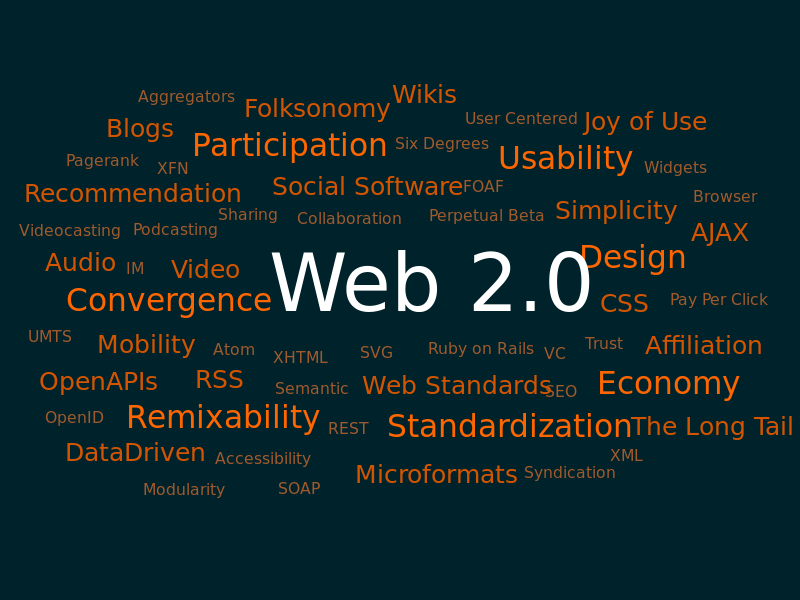
Wikipedia defines Web 2.0 as: "web applications that facilitate interactive information sharing, interoperability, user-centered design and collaboration on the World Wide Web" (Wikipedia) To think about the amount of things that I simply did in this one blog entry though the use of HTML or XML is crazy, and we don't even realize it most of the time (because normally the computer/website does it for us, like Blogger!). The simplicity we are creating will last for years to come and will continue to prosper even after our death. Wikipedia also uses the image below to describe what Web 2.0 is, and what words are normally associated with it.
REMEMBER it is us who is changing the future of Web 2.0 and beyond, and we are doing so without even knowing it!
Protecting Youths on the Cyber Playground
According to a CNN article published today, social media web sites Facebook and MySpace have deactivated the accounts of over 3,500 registered sex offenders in New York State. These websites used a state law which requires these people to inform the state of their email addresses and any online aliases that they would be using. The New York Attorney General said that the offenders were in violation of their parole by interacting with children in an online environment.
I personally am somewhat torn on the issue. The largest part of me is satisfied with the decision of the social networks. As a young adult and future parent, I absolutely want children to have the utmost protection, particularly over the Internet. However, I could also understand how some people would say that this begins to infringe on the personal liberties of these citizens. It is a complicated decision, but I feel that Facebook and MySpace protected both themselves and children using the site by taking this measure.
The Flaws of Communicating in Cyberspace & Technology
While the title of this post is a bit of a play on our book title, in chapter 21, Rushkoff describes some of the flaws of "communicating" over the certain mediums. For example, he describes the issues within communicating in a video game, multimedia cd-rom, or web site. Within all of these, the communication is simply one dimensional, even if the user gets to pick his own direction.
A video game has been preprogrammed to let the player choose his own direction. While the player is able to follow his own path in the video game, all possible options have already been exhausted by video game developers. There is no possible decision the player could make that has not been already. The player moves within the constraints of the game.
A multimedia CD-rom is very similar to a video game. Like the "choose your own ending" stories we saw in class, a multimedia CD-rom lets the user pick his own direction, but all possible outcomes have been previously thought out by the developers. The person may think he is choosing his own direction, but truly it is the CD-rom developers who have actually come up with any possible ending.
At the time this book was written, the web was not into its full blown "web 2.0" stage. Communication on the web was one sided, with news and information being simply conveyed to the online reader. It is "a simulation of free choice" (350). In this, the reader is simply told information. But now with the rise of social media such as MySpace, Facebook, and Twitter, each person has the chance to publish and respond to anything he wants. The web became 2-directional with each user able to communicate with others, respond to stories, watch and comment on videos, and so forth. With the ability for so many different people to publish their own information, good and bad material has come. But, I don't think that anyone would argue the bad that the internet offers outweighs the good
A video game has been preprogrammed to let the player choose his own direction. While the player is able to follow his own path in the video game, all possible options have already been exhausted by video game developers. There is no possible decision the player could make that has not been already. The player moves within the constraints of the game.
A multimedia CD-rom is very similar to a video game. Like the "choose your own ending" stories we saw in class, a multimedia CD-rom lets the user pick his own direction, but all possible outcomes have been previously thought out by the developers. The person may think he is choosing his own direction, but truly it is the CD-rom developers who have actually come up with any possible ending.
At the time this book was written, the web was not into its full blown "web 2.0" stage. Communication on the web was one sided, with news and information being simply conveyed to the online reader. It is "a simulation of free choice" (350). In this, the reader is simply told information. But now with the rise of social media such as MySpace, Facebook, and Twitter, each person has the chance to publish and respond to anything he wants. The web became 2-directional with each user able to communicate with others, respond to stories, watch and comment on videos, and so forth. With the ability for so many different people to publish their own information, good and bad material has come. But, I don't think that anyone would argue the bad that the internet offers outweighs the good
Is Twitter really the way to God?
Twitter, the popular social media network for micro-blogging was recently dubbed the most popular word of 2009. The Global Language Monitor declared “Twitter” as the top English word of the year. In a Time.com article, technology writer Clive Thompson says that by following these quick, abbreviated status reports from members of your extended social network, you get a strangely satisfying glimpse of their daily routines. We don't think it at all moronic to start a phone call with a friend by asking how her day is going. Twitter gives you the same information without your even having to ask.
Twitter is gaining popularity at lightning speed. It had a huge effect on Black Friday sales, with retailers “tweeting” deal, hoping to catch the attention of their followers. James Fielding, President of Disney Stores Worldwide is quoted as saying, “I think in this economy you need to leverage every asset that you have.” This past Friday, Fielding tweeted, “We have amazing ONE DAY ONLY deals previewing on our Facebook page — become a fan today and find out more!”
While I think taking advantage of Twitter, Facebook and other new forms of social media, how much is too much? This question came to mind when I came across a Time.com article entitled, “Twitter in Church, with the Pastor’s O.K.” The article profiles John Voelz, a pastor at Westwinds Community Church in Jackson, Michigan who has embraced Twitter and taught his congregation how to use it. Voelz spent two weeks teaching his parishioners about the site and how to use it. After no time, tweets were appearing on screen in the training session with things like, “I have a hard time recognizing God in the middle of everything" and "The more I press in to Him, the more He presses me out to be useful.”
Is this really appropriate? Voelz seems to think so. Instead of reminding worshippers to silence their cell phones, he is encouraging them to integrate text messaging into their relationship with God. Some believe that it is the Church’s responsibility to leverage current culture to their advantage, in order to draw young people in. Actually, Bible verses can frequently be found in pop culture. Here are two unexpected examples:


On the other hand, many believe that there is a time a place for technology, and Sunday morning Mass isn’t is.
I personally do not believe that Church is the time/place for social media sites. I know if there was a screen in the front of my Church displaying Twitter, I would watch that the whole time rather than pay attention to the Mass. And if, for some reason, I wasn’t paying attention to what’s going on up on the altar, shouldn’t I be reflecting on my life throughout the past week?
Monday, November 30, 2009
Web 2.0 and Social Media
People like to be connected and the desire for such connectivity has given exponential growth to social media. We are in constant want and/or need to stay in contact with our friends, family, and at times keep up with people that we may not even know all to well or not all. Sometimes its mind boggling that people care about or give so much attention to the most insignificant tweets or status updates. People don’t want to be left out of the loop and always want to know what’s going on.
The emergence of Web 2.0, "web applications that facilitate interactive information sharing, interoperability, user-centered design and collaboration on the World Wide Web (Wikipedia)" seems to have given rise to social media. It has created interactivity in which users are not merely passive observers, but instead are able to participate with the websites content. The ability to participate created an engaging attribute to the web and thus provided people with something to do online. When people became participants and producers of a websites content, social media began to thrive.

People are constantly in motion and therefore we need something to keep in touch. An increasing number of people are enabling internet on their phones because that's their main outlet of communication. Even if your on the run, staying connected is not an option, it has become more of a necessity.
"Stay in-the-know wherever you go with wireless access to: status updates, friend requests, photos, wall posts, and messages." Blackberry's ad reveals that although people may be fast-paced and mobile, we never truly become disconnected from our social networking sites (what may now be our main source of social connectivity).
Perhaps this progression towards social media is merely a normal phase of the evolution of communication, such as the movement from the telegraph to the phone. Some people are still weary of social media and have not yet adapted to it. However, I believe that in the long run most people will feel comfortable with the idea and the use of social media, much like other mediums of communication. Maybe next semester the use of twitter will be required for this class and people our age will personally find out what all the hype is about.
Interesting Social Media and Web 2.0 presentation that I found on the web:
The emergence of Web 2.0, "web applications that facilitate interactive information sharing, interoperability, user-centered design and collaboration on the World Wide Web (Wikipedia)" seems to have given rise to social media. It has created interactivity in which users are not merely passive observers, but instead are able to participate with the websites content. The ability to participate created an engaging attribute to the web and thus provided people with something to do online. When people became participants and producers of a websites content, social media began to thrive.
People are constantly in motion and therefore we need something to keep in touch. An increasing number of people are enabling internet on their phones because that's their main outlet of communication. Even if your on the run, staying connected is not an option, it has become more of a necessity.
"Stay in-the-know wherever you go with wireless access to: status updates, friend requests, photos, wall posts, and messages." Blackberry's ad reveals that although people may be fast-paced and mobile, we never truly become disconnected from our social networking sites (what may now be our main source of social connectivity).
Perhaps this progression towards social media is merely a normal phase of the evolution of communication, such as the movement from the telegraph to the phone. Some people are still weary of social media and have not yet adapted to it. However, I believe that in the long run most people will feel comfortable with the idea and the use of social media, much like other mediums of communication. Maybe next semester the use of twitter will be required for this class and people our age will personally find out what all the hype is about.
Interesting Social Media and Web 2.0 presentation that I found on the web:
Web 2.0 and Social Media
View more presentations from Shantanu Adhicary.
A Very Merry Twitter Holiday
This past Friday, hordes of deal-hungry Americans woke up at unimaginably early hours to wait in excruciatingly long lines, pillage a $3.99 DVD bin, and get what could be the "lowest price of the season" on a popular toy for their eager adolescents. However, what makes this years Black Friday different from others is that this is America's first Twitter Holiday.
According to a recent NYTimes Article, "retailers and their customers used the social networking site to talk to one another about bargains, problems, purchases and shopping strategies." Tech savvy black Friday shoppers used Twitter as their guide to discounts around the retail sphere and most who did say that they benefited more than just shopping with your average black Friday sale circular. Some Twitter-exclusive deals included a coupon for 15% off a purchase of $75 or more at the Gap Outlet and the special "One Day Sale" from Disney, which previewed exclusively on their Facebook page.
However, Best Buy is one of the most remarkable retail Twitter users this holiday season;
In chapter one of Communication and Cyberspace, Gumpert & Drucker posit the excitement of progress and technological developments in that "being able to connect with the outside world from our intellectual dungeon is amazing and helpful, but it is much more difficult to forecast the impact of such developments." Twitter, the most used word of 2009, allows people to connect with the outside world in unimaginable ways; Tweets can theoretically be seen by millions of people and with the nature of a tweet being 140 characters or less, this spurt of information is tangible and useful for more people compared to a traditional blog or facebook post, which can be wordy and not get to the point in the same concise fashion as Twitter. This is why for businesses, Twitter is a goldmine.
Did retailers ever think that Twitter would become so large that they would be increasing their use of social media this holiday season by 47% ("Buying, Selling and Twittering all the Way." New York Times. Nov. 27, 2009)? Probably not. The power of Twitter for businesses is growing exponentially and the developments with how to better utilize Twitter, a la Best Buy's Twelpforce, is a perfect example of how a company is already making advancements in a nascent form of communication to sataisfy customers in an instant gratification, palm-of-your-hand type of way.
Twitter is a prodigious playground with growing possibilities. As seen with this years black Friday, retailers have the ability to directly address the consumer and make them feel heard and noticed. What advancements will Twitter and other forms of social media and web 2.0 make in 2010? Perhaps you will be able to download a holographic Best Buy employee to help you set up your new home theater system.

According to a recent NYTimes Article, "retailers and their customers used the social networking site to talk to one another about bargains, problems, purchases and shopping strategies." Tech savvy black Friday shoppers used Twitter as their guide to discounts around the retail sphere and most who did say that they benefited more than just shopping with your average black Friday sale circular. Some Twitter-exclusive deals included a coupon for 15% off a purchase of $75 or more at the Gap Outlet and the special "One Day Sale" from Disney, which previewed exclusively on their Facebook page.
However, Best Buy is one of the most remarkable retail Twitter users this holiday season;
"A few months ago, Best Buy began piloting a Twelpforce — a Twitter-inspired play on “help force” — of some 2,500 employees that answer consumers’ questions in real time. After buying a new navigation system at 6 a.m. on black Friday, Laura S. Kern of Los Angeles could not figure out why it was not giving her traffic updates. She sent a message to Best Buy’s Twelpforce account and within five minutes not one, but two Best Buy employees responded with fix-it advice ("Buying, Selling and Twittering all the Way." New York Times. Nov. 27, 2009)."
In chapter one of Communication and Cyberspace, Gumpert & Drucker posit the excitement of progress and technological developments in that "being able to connect with the outside world from our intellectual dungeon is amazing and helpful, but it is much more difficult to forecast the impact of such developments." Twitter, the most used word of 2009, allows people to connect with the outside world in unimaginable ways; Tweets can theoretically be seen by millions of people and with the nature of a tweet being 140 characters or less, this spurt of information is tangible and useful for more people compared to a traditional blog or facebook post, which can be wordy and not get to the point in the same concise fashion as Twitter. This is why for businesses, Twitter is a goldmine.
Did retailers ever think that Twitter would become so large that they would be increasing their use of social media this holiday season by 47% ("Buying, Selling and Twittering all the Way." New York Times. Nov. 27, 2009)? Probably not. The power of Twitter for businesses is growing exponentially and the developments with how to better utilize Twitter, a la Best Buy's Twelpforce, is a perfect example of how a company is already making advancements in a nascent form of communication to sataisfy customers in an instant gratification, palm-of-your-hand type of way.
Twitter is a prodigious playground with growing possibilities. As seen with this years black Friday, retailers have the ability to directly address the consumer and make them feel heard and noticed. What advancements will Twitter and other forms of social media and web 2.0 make in 2010? Perhaps you will be able to download a holographic Best Buy employee to help you set up your new home theater system.

Making the Concrete. Abstract
Chapter 18 by Paul Lippert titled, "Cinematic Representations of Cyberspace" discusses the manner in which film has been able to manipulate concrete ideas and make them abstract in a manner which print couldn't do. I found this observation very compelling because it reminded my of the Multimedia classes I had taken in high school.
Lippert mentions how the placement of characters in a scene can create an abstract meaning. On page 298 he makes this point that if a character is standing in front of a group of others in a shot, the spacial arrangment of the characters is concrete, however the idea that this one individual is in the foreground illustrates an abstract idea that he or she is over importance. This idea of positioning adds a dynamic to film that print culture couldn't accomplish. Similarly, camera angles play a large role in creating abstract ideas of characters. A low camera angle with a character seeming larger than life creates a sense of power and vice versa.
Print was only able to do the opposite and make concrete what was abstract. Ideas of things beyond the physical world could be captured by words in print but couldn't go the other way.
Lippert mentions how the placement of characters in a scene can create an abstract meaning. On page 298 he makes this point that if a character is standing in front of a group of others in a shot, the spacial arrangment of the characters is concrete, however the idea that this one individual is in the foreground illustrates an abstract idea that he or she is over importance. This idea of positioning adds a dynamic to film that print culture couldn't accomplish. Similarly, camera angles play a large role in creating abstract ideas of characters. A low camera angle with a character seeming larger than life creates a sense of power and vice versa.
Print was only able to do the opposite and make concrete what was abstract. Ideas of things beyond the physical world could be captured by words in print but couldn't go the other way.
Saturday, November 28, 2009
Mass Media Manipulator
Chapter 21 in 'Communication and Cyberspace', discusses how our two way communication is surprisingly one way. The media can control most of the news that affects us by presenting information in a way that we regard as living communication. The imitation, however, is the broadcasted one-way view of worldwide sponsors. When we receive information, it has been formulated in a way that captures are attention and plays into our desires, fears, and aspirations. In chapter 21, author Douglas Rushkoff highlights how the media can take data and turn it against us. For example, Counterinsurgency air force brigadier general Edward G. Lansdale, worked for the CIA and gathered information about the Huk rebels in the Philippines just after World War II. He learned that this group of people was very superstitious and greatly feared vampires. He capitalized on their fears by quietly capturing one of their men and killing him by puncturing two holes in the side of his neck and then draining him of blood. They would leave the man to be found by his tribe early the next morning. When the tribe did come across the victim they would retreat in fear of vampires. Essentially this tactic "depends on concretizing living myth with fixed data. They invariably mine the most fertile cultural soil for inherent inconsistencies, and then replace them with symbols that can be more easily controlled"(pg 353).
This story relates to our mass media because marketers do what General Lansdale did everyday. They distribute surveys and other polling options that require our feedback, essentially allowing them to identify our target needs- allowing us to become the victims of an eventual marketing attack. In many ways advertising is becoming more and more specific. As companies now can literally map out each of their target customers likes/dislikes and preferences using stored information from their computer's history of past purchases, we might see a trend of getting advertising that applies to us specifically. In a way I'd rather see coupons for things that pertain to my life and advertsing that 'knows me' - even if it is a little bit 'Big Brother-ish'.
Communication and Cyberspace: Chapter 21
This story relates to our mass media because marketers do what General Lansdale did everyday. They distribute surveys and other polling options that require our feedback, essentially allowing them to identify our target needs- allowing us to become the victims of an eventual marketing attack. In many ways advertising is becoming more and more specific. As companies now can literally map out each of their target customers likes/dislikes and preferences using stored information from their computer's history of past purchases, we might see a trend of getting advertising that applies to us specifically. In a way I'd rather see coupons for things that pertain to my life and advertsing that 'knows me' - even if it is a little bit 'Big Brother-ish'.
Communication and Cyberspace: Chapter 21
Critical Perspectives
In Chapter 1, 'From Locomotion to Telecommunication, or Paths of Safety, Streets of Gore', I was struck by the story of David Alsberg. He was an innocent bystander killed by a stray bullet during a robbery in Times Square. The book describes how his family grieved, but so did his online world- the friends he had in cyberspace. They had an online wake for him in an electronic forum- I thought of the WOW funeral we observed in class. The chapter went on to quote the population of cyberspace ( between 30-35 million people ). As more people are choosing to communicate, explore, discover, and socialize online, rather than doing so in the real world, are we becoming a generation that seeks social isolation. As cyberspace grows, are we retreating to the confines of our own homes- behind our own computer screens?
The epilogue of chapter one said it best:
"Once upon a time, not so many years ago, people could go out into the city lights when the fancy struck them, when they had nothing better to do, when it occurred to them that it might be fun to be with others. Sometimes it was necessary to walk into the street to find out what was happening in the world. They wandered out into the square to talk, to the cafe to contemplate their lives over a cup of coffee, to the park to stroll among others, to the pub to flirt with those who were there to rush the blood, to the bench where ancient memories reside, to the chess tables to advise and criticize, to the public realm to vanquish loneliness, discuss politics, or simply talk. But it is no longer that time past, and the old and familiar have often become hostile and menacing. We sadly step back and find other possibilities and less threatening opportunities to play and frolic- safely, often alone."
Communication and Cyberspace: Chapter 1
The epilogue of chapter one said it best:
"Once upon a time, not so many years ago, people could go out into the city lights when the fancy struck them, when they had nothing better to do, when it occurred to them that it might be fun to be with others. Sometimes it was necessary to walk into the street to find out what was happening in the world. They wandered out into the square to talk, to the cafe to contemplate their lives over a cup of coffee, to the park to stroll among others, to the pub to flirt with those who were there to rush the blood, to the bench where ancient memories reside, to the chess tables to advise and criticize, to the public realm to vanquish loneliness, discuss politics, or simply talk. But it is no longer that time past, and the old and familiar have often become hostile and menacing. We sadly step back and find other possibilities and less threatening opportunities to play and frolic- safely, often alone."
Communication and Cyberspace: Chapter 1
Tuesday, November 24, 2009
Pornography
The topic i found most worthy of comment was the pornography industry and its hold on the cyberspace world. I was astonished at how evidence supports the claim that porn has driven many technological advancements. It is clear that the porn industry makes the internet what it is today.
Personally, i am quite surprised at this fact, as i was under the impression since the government first created the internet, porn would be last on the list. I guess it goes to show you that sex truly does sell.
Cyberspace: A Neverending Story
The Internet has come a long way since its birth in the 70s with ARPAnet. What began as an organized controlled sphere of data has evolved into flowing and constantly adapting stream of culture and information. In chapter 3 Beniger uses the analogy of paths flowing through the Harvard campus. Like the Internet, as time passed, what was once sufficient is no longer appropriate. The web evolves as it sees fit. No one tries to change the Internet it just happens naturally.
The Internet itself doesn't change, the people who utilize it do, and with these changes new meanings come to old ideas. The Internet at its core is the same. It functions in same way, i.e. It is the home of free flowing information available to anyone with access. If you were to look at the original ARPAnet, and compare it to today's world wide web, it would be easy to say that they are unrelated and share no ties. This however is inaccurate. Rather than taking them as two separate entities, one should consider the world wide web as something which is ever-expanding.
At the core of this web is ARPAnet, because this is where it all began. As new developments emerge, such as how the united postal service utilized the net, a web of tentacles begins to unfold and expand outward in all directions. In 20 years no doubt we will be using the Internet in ways we cannot fathom today. The world wide web will probably become a tech term of the past, like ARPAnet is today. But this is not to say that whatever will emerge is not intrinsically linked to the technologies of the past.
The Internet itself doesn't change, the people who utilize it do, and with these changes new meanings come to old ideas. The Internet at its core is the same. It functions in same way, i.e. It is the home of free flowing information available to anyone with access. If you were to look at the original ARPAnet, and compare it to today's world wide web, it would be easy to say that they are unrelated and share no ties. This however is inaccurate. Rather than taking them as two separate entities, one should consider the world wide web as something which is ever-expanding.
At the core of this web is ARPAnet, because this is where it all began. As new developments emerge, such as how the united postal service utilized the net, a web of tentacles begins to unfold and expand outward in all directions. In 20 years no doubt we will be using the Internet in ways we cannot fathom today. The world wide web will probably become a tech term of the past, like ARPAnet is today. But this is not to say that whatever will emerge is not intrinsically linked to the technologies of the past.
Gamer
While reading Chapter 18, I could not help thinking of a movie that I saw recently: Gamer, featuring Gerard Butler. While far from being a cinematic masterpiece, it provided an interesting interpretation of the blurred line between cyberspace and "real life", and also of the dangers of relying on mass media. In the movie, Butler is simultaneously a video game character and a human being. This is made possible by mind control technology used on death row inmates to provide entertainment for those with the money to play the game. To a large degree, the movie is meant to make the audience sick and to be wary of technology on the whole, media in particular.
 Gerard is not to be messed with.
This resonated with me particularly because of Lippert's assertion that "science and technology increasingly have distanced us semantically and experientially from this lifeworld, our ideas and their images have become similarly remote." I would contend that in certain instances, such as in Gamer or The Matrix, technology becomes a replacement for the real world, but does not necessarily make an attempt to distance space from cyberspace.
Subscribe to:
Posts (Atom)