Tuesday, November 10, 2009

Hypertext


"The book is obsolete," declared theorist Marshall McLuhan ... He was quick, though, to explain himself: "Obsolescent does not mean extinction. Quite the contrary. For example, handwriting has been 'obsolete' since Gutenberg, and certainly since [the typewriter], there is more handwriting today than there ever has been." Instead, the book, he suggests, will be raised to an "art form."

He makes a good point in that just because we have keyboards and computers doesn't mean we have left our pens and paper idle. I write every day, and I also enjoy reading a text book rather than reading from a computer screen. Will we ever leave books behind for good? I can't imagine that happening. Although in our book Communications and Cyberspace, in chapter 17 (Pedagogy and Hypertext), author Stephanie Gibson argues that the hypertext form can be utilized in the classroom in many ways. For some, the textbook remains a one dimensional means whereas hypertext allows you to discover and interact with the material you are learning. Gibson sites one of the earliest interactive hypertext packages- The Perseus Project- that allowed it's user to explore ancient Greece. There were " archaeological photographs and diagrams, photos of period artwork, plays in the original Greek language with translations, contemporary commentary, maps, and several glossaries all linked together to allow myriad approaches to the material" (Gibson 282).


Internet Writing and Hypertext

In chapter 16, Paglia discusses the many aspects of internet writing. Paglia states:

“The key to Internet writing for me is visual, not verbal. Ever since computer operating systems progressed from half-mathematical ASCII to today’s lively, colorful, high-resolution graphics HTML format, the Internet has become a mercurial hybrid of word, image, and sound.”

Although Paglia’s format of writing can be more visually appealing, it can still be difficult to capture the attention of the reader. I always see myself reluctant to read long articles online and I’d rather print them. In some ways, there is a connection that you gain with the print version that doesn’t exist while reading online. I don’t see myself purchasing a kindle version of a book anytime soon.

However, in chapter 17 Gibson makes some interesting argument. Gibson states:

“All the qualities of hypertext encourage vastly different habits of thought than does traditional print. Hypertext has been called a democratizing medium because it allows everyone access to both production and decoding. This may be said of it both internally and within its larger environment. Internally, for example, hypertext is able to show clearly interconnectedness between ideas by linking them together. Although this is not completely impossible in print, it is structurally difficult to include massive amounts of material in a single text. “

I have to agree that hypertext can create a broader reach of ideas and can be used to search more efficiently for whatever is relevant to the reader. However, it is hard to fathom the traditional textbook in the classroom not existing because of hypertext. Gibson also suggests that a shift from traditional print textbooks to hypertext will inevitably take place in the classroom. The interactivity of hypertext and its ability to create a visually and increasingly informative environment will be an integral part of education, but I don't think it will eliminate or drastically decrease the use of textbooks.

Hypertext

What is hypertext? Hypertext is text which is not constrained to be linear. Hypertext is text that is linked to other texts. The founder of hypertext Ted Nelson around 1965. Hypertext is a concept more than anything else. This picture illustrates a way in which we can look at hypertext.:


The uses for hypertext are endless. The World Wide Web combines computer networking (the Internet) and Hypertext MarkUp Language (HTML) into an easy to use system by which people can access information around the world from a desktop computer. Hypertext is the medium used to transmit the information in a non-linear fashion via computer by clicking on a "link" using a mouse.

Hypertext


Hypertext is used with hyperlinks that refer you to other links that are related to what the user is reading. Hypertext can be static or dynamic. Static hyper text is mostly used for cross-references of data in certain documents. Dynamic hypertext continuously changes in response to user input.

Textbooks vs. Hypertext

In Chapter 17, Pedagogy and Hypertext, Gibson talks about how educational institutions had a hard time accepting hypertext and digital learning tools in the 1990s. She describes The University of Maryland, Baltimore County, saying that they did not build a computer science building because they felt it would not attract students. She goes on to say, "Those people who were attracted to the study of computers went on to design computer programs that now invisibly pervade our everyday lives. ATMs, Game Boys, palm pilots, cell phones, Nintendos, cars that think, appliances that make phone calls, and the Internet itself, to name just a few manifestations, are integral parts of American life." (p.278) Later in the chapter she discusses the transition from traditional textbooks in the classroom to hypertext and digital learning tools. Gibson says that there are two extreme ways of looking at textbooks, either as a driving force behind curriculum decisions or as simple tools for classroom interaction. She goes on to describe the possibility of hypertext replacing textbooks, saying it could provide a more comprehensive and interactive coverage of subjects. She says, "an oft-heard comment during a summer workshop, and since, is that hyptertext is a way to hold student interest. It is dynamic, contains several approaches to the material, and appears to give readers/users a choice about how the material will be experienced and studied." (p.287)

I think hypertext has huge potential in the academic world. It is a powerful tool that allows teachers to best meet the needs of each individual student. On the other hand, it would be sad to see all books go digital. There is something unique about opening a new book, turning pages as you read, and physically seeing yourself progress through the book.

Monday, November 9, 2009

Hypertext Hierarchies?

After reading "Pedagogy and Hypertext", I realized why it is that I am able to understand internet content much easier than printed, written content.
The internet, according to Gibson, has "no hierarchy of ideas as is evidenced in a table of contents or outline" (284). By giving the reader to choose the direction that he wishes to continue in, the reader is able to learn in the manner that best suits him. I find myself having a tough time with a solid, rigid structure so the internet's ability to help the reader maneuver through the material relevant to him is great. There is no overarching structure to the internet; it is strictly organized "not in order of importance, calling into question not only hierarchies of ideas, but the notion of prerequisites" (284). It is this "choose your ending" style that gives the internet the power it has to convey information to a reader.

Is It So Wrong To Use Electronic?

I found a section in Chapter 16 by Camille Pagila that discusses and tries to define something that I most definitely relate with: me. In Pagila’s discussion of “Writing for the Internet”, she discusses the fact that college students rely on the Internet and other electronic resources for their information.

“College students, even in the Ivy Leagues, may spend from 2 to 5 hours a night on the internet….Today’s college students were born in the 1980’s, when newspapers, a major melting-pot medium for a century since the start of immigration era, had already lost ground to television"


I personally do not know how I should take that statement. On the one hand, yes, it is true. I know I speak for most of us when I say that we spend a great deal of time online. Most of us depend on the Internet for our information; anything from news to emails to file transfers to this blog. So although we’ve been cited for spending so much time online, my question is, is it so wrong?

I know that on a day to day basis, I use my computer for just about all of my written communication. I check my email, I write to friends, I go on my favorite gossip blogs; I even go as far as bringing my computer to class to type out my notes such that I have all my information in neat, typed form. However, Pagila seems to hold it against us that we no longer (typically) turn to newspapers for our first source of information. I understand that newspapers may seem tradition; however, why should we hold ourselves back when it comes to receiving information? I like reading my newspaper every now and then, but I turn to the easiest source of information; electronic.

The Textual Convo

"Although asynchronous communication all but guarantees that the e-mail messages we recieve were composed at some point in the past, there is a tendency to experience them as if they were being communicated in the present (Strate, Communication and Cyberspace. p. 379)."

When you are having an Instant Message conversation with someone over gchat, facebook or AIM there is a synchronous interaction happening. When you are reading an email thread or a discussion on a message board you are reading a asynchronous interaction. However when you read an IM and you read a discussion thread, what is the difference besides waiting for the instant reply from the other person? After you complete the IM conversation with with someone, you can go back and read the conversation as if it is happening instantly again. There is a "sense of immediacy," as Strate points out, when you read a discussion, whether synchronous or asynchronous, and the reader can't help but to feel that the conversation is happening instantanously when the reality is that it could have happened hours, days or weeks a part.

This is sort of related to an implied textual emotion. Those who text, IM and leave facebook wall posts know that a different connotation can be applied to any blurb of text and by adding symbols like "!!!!" or ":)" and can make all the difference. Sure, text is text and a word is a word, but when you add these symbols to your online writing, you create a textual personality for yourself almost to the point of others being able to sense if a person is not who they say they are on the other side based on the textual emotion being exuded.

The Effects of Hypertext

After reading chapter 17, "Pedagogy and Hypertext" by Stephanie B. Gibson, I realize how little understanding of hypertext I had. To me hypertext was just links and internet buttons which lead you to another page or to more information. I failed to fully grasp the effects and consequences of hypertext, especially in education. In the article I found it very interesting how Gibson discusses the implications hypertext has on education. From reorganizing the way education works in a classroom with respect to teachers and students and how the authority works. Hypertext takes away the authority of teachers and their textbooks and shift to students and their own learning experience by using the information in programs. Even though this is only one example, the chapter covers numerous ways that hypertexts change the academic scope of material we use to learn.
If teachers introduce hypertext into their classroom it takes away from their control. Let's say a teacher uses a computer program which students use to help them learn. What is the teachers role now? It is simply a director, someone who guides the learning process instead of being an active member of giving the material to be learned. Students can wonder on these programs and gather information the teacher may not be ready to discuss yet or may not be necessary. If a student has a question about something they haven't gone over, that teacher must then be ready for everything which takes away from the organization and control of the class.

Friday, November 6, 2009

Effects of the Internet

"Since the mid-1990s, the Internet has caused a tremendous cultural shift whose most profound impact has been on young people. It will take another 30 years before the Internet's effects are clearly understood. The computer has literally reshaped the brain of those who grew up with it..."(268)

The Internet has allowed for a new basis of which we socialize (facebook) and retrieve information (wikipedia.) It is now possible to reach anyone anywhere in the world and to retrieve facts in only seconds. Is this convenience making our generation more intelligent or more lazy? Studies have shown that the areas of the brain which control decision making and complex reasoning double in activity among new internet users. However, internet users show a decrease in their capacity to concentrate on given tasks. Using the internet may be rewiring our neuron connections. Paglia raises a very thought provoking point when he states "It will take another 30 years before the internet's effects are clearly understood." It seems that everyday interent use is reaching a new pinnacle. How will internet use effect the behavior and evolution of humans in the future? As I look at my 2 year old nephew unwittingly pressing on the keyboard, I wonder how the use of computers from such an early age will effect his cognitive development. In other words, is his mind at advantage or disadvantage by being entertained by interenet sites. Internet use has become so prevalent that it may be taking away from people's social skills as they spend hours on end in front of a computer, they may be losing out on critical life experiences.

Tuesday, November 3, 2009

The Key to The Keyboard

In chapter 19 of our text, Judith Yaross Lee discusses the idea of what is in a particular body of online text (specifically email) and the way in which we perceive it. She goes on to discuss the ways in which this information is presented to us,

“…the convention of upper and lower case letters, a visual and spatial distinction devised for pint, becomes a means for indicating loudness. Similarly, the emoticon converts the finite alphanumeric keyboard into a source of nearly movable types…”

I thought this particular paragraph to be interesting in regards to the future of literacy. When we are talking with friends online or through email, we tend (or at least I, myself, find) that we become lazy. Instead of “you” it become “u”, if we’re happy, we tend to write :-) to convey emotion, and we even go so far to stop capitalizing “i”, simply because the computer will convert it for us.

But how soon will it be that we’ve translated the way that we write to our friends into the way that we write formally? With all the different ways in which we use the keyboard to convey our emotions and feelings, as stated by Lee, what’s to stop us from starting to use those methods of typing in a formal setting? We have a keyboard with vast options to convey our messages. For example, iF I typed LiKe ThIs, not only would you probably want to smash my keyboard, but you also might think that I am a 12 year old girl writing online for the first time. IF I STARTED TO TYPE LIKE THIS, you might think that I was angry at the fact that I have to continue typing. if i just simply typed like this n didnt care if i was riting formally or not, u mite think i was just talking to a friend.

Our keyboards help us to convey a message, but how does that message “convey” us? And how much longer will it be that we use these different ways of typing before they all blur together into one, non-formal, way of communication?

Online Education Unbound

Chapter 13 discusses the attributes of online education. Levinson suggests that some people have obstacles that prevent them from having a traditional in class education. These obstacles are obstacles of geography, time, retention, economics, teacher domination and physical disability. At the risk of sounding redundant I won’t explain each obstacle since a few of you have already touched on the subject. Although many of these obstacles are pushing people towards online education, many people are still wary about receiving an online degree. There are many fake online colleges also known as degree mills that are not accredited by a recognized agency or are accredited by fake agencies. This may be one of the biggest reasons why I wouldn’t want to get an online education. The fear that the online university is not reputable will most likely drive me away.

However, sources such as geteducated.com as committed themselves to “rate, rank & compare online schools & degrees.” With such information available, people have been more inclined to get an online education without having to fear the many scams that are out there. In addition, traditional top tier schools such as Boston University, Penn State University and many others are now offering online degree programs. As people begin to see online education as a viable and increasingly more efficient way of receiving a degree, it may become a vital part of our educational endeavors.

In addition, here is a video of CNN reporting on online education:

Online Education

Levinson writes about the bounds and constraints of normal education environments that online courses can allow. It is true for many people that an education cannot be pursued in order to maintain their job and reasonable way of life. Online courses offer these people the opportunity to be enlightened and gain an education while they complete the responisbilities of work. It may be difficult for some of us to understand that there are people who would love to be in the classroom environment but simply can't because of their obligations to family and their need for survival...e.g. working. I believe that online courses are a great idea and give an opportunity to those who are not fortunate enough to have the leisure time for the physical classroom to emancipate themselves from the boundries which the physical classroom may entail.

Education and Virtual Reality

In chapter 12, Terri Toles Patkin, the articles' author discusses the use of multimedia simulation in education. I found the idea of a virtual "internship" particularly interesting. Patkin says, "Students could try working in a small family business or a Fortune 500 headquarters during a single semester. They could then select the type of organization they would prefer to concentrate their efforts on in the future." (p. 204) He goes on to say that such a virtual organization would supplement, not replace, textbook, classroom and internship experiences.

Virtual reality simulators could also be used for other real-life purposes, such as training people in cross-cultural communication. For example, an American businessman could practice appropriate negotiation skills with a virtual Japanese client. The beauty of virtual reality used for educational purposes is its ability to present a simplified reality to the beginner, with complicating factors stripped out of the scenario until the student is ready to handle more complexity. For example, a flight school student may use a simulator to practice landing a plane and as he or she gets more comfortable the system may add a crosswind to the simulation.

The "Virtual Intern"

In Chapter 12 of Communication and Cyberspace, the idea of students participating in a Virtual Organization surfaces. It states that "Communication students who get the chance to intern in organizations today generally report dissatisfaction with the tasks they are assigned. Dreams of creative fulfillment tend to be misplaced among the filing, telephone duty, and fact checking that typically constitute the intern's job description. Often the experience of a corporate environment and the change to "network" provide more valuable experiences for the student that the substance of the assigned tasks" (p. 204). Being an intern myself, this is very close to my personal work experience. 
I work as a sales/public relations intern for the fashion designer, Derek Lam, and my background in communication enables me to easily perform some of my given tasks. Some of these tasks include tracking samples of clothing, where we scan a barcode of the sample and through a virtual computer program it shows exactly where that sample is, whether it be somewhere in the United States or even Milan or Japan. I have been given the chance to "network" while attending events held at different department stores and also put in my personal creative input by styling mannequins. Other tasks include designing templates of picture of the runway shows and doing competitive analysis reports by researching department store websites to compare prices of other designers. I would consider myself a "virtual intern" because of my thorough use of the web and computer during my daily work activities. 

Why Online Education?

Chapter 13 focuses on the advantages and drawbacks of online education. This has a great influence in our culture today. We see many television commercials advertising online education, or learning at home on your own time. That is one of the greatest advantages to online education, being able to do it on your own time. You do not need to attend a class at a specific time during the day, but instead can do it on your own time when you are fully awake, willing to learn, and willing to give back to the discussion.
In some research, I found a lot of debate around online education and the degrees received from it. Many people were willing to defend online education and "kill" the lies about online education, exclusively found on this website, which also contains a web page including 15 benefits of online education. This site: Online Education Lies includes 5 lies revealed that tend to dissuade people from using these programs.
I think that we are deterred from using these programs because of advertisements we see for them and how outdated they appear. For me, I had no need to use online education and see one of the great disadvantages of it being the lack of possibility to have a hands on experience. Online education, though always accessible, does not allow for the teacher/student relationship that can occur in normal institutional, as well as the non-existence of a campus and the idea of who else is in the class. As students at an institution, we have no need to use online education but it is true that there are many, many people out there that do need this form of education to spend both their time working as well as getting a degree. It will continue to have the advantages and disadvantages that currently exist no matter what may change.

VR's Return to Plato's Cave

I'm posting on the topics from last week as somehow last week I misread the syllabus and posted about this week's reading. With that said -- I found Zettl's comparison between virtual reality and Plato's cave to be interesting. He discusses the implications of VR and how it is a modern day cave.

In VR, the person is able to escape to another world - one without any sort of physical repercussions. For example, in flight simulators if the pilot crashes, there aren't any actual physical repercussions. He/she is able to learn without actually experiencing harm. It is as if they are exposed to the light Plato discusses without actually having to change their lifestyle. I found this comparison to be most interesting when thinking about games like The Sims or Second Life. In these games, the player is actually able to simulate a family or simply create an avatar that represents who that player is/wants to be. Like Zettl says, these players have "a yearning for not being held accountable for our decisions" (108). The player is able to create a family, be responsible for day to day life, and interact with people without any true physical contact. It truly is the modern day "cave."

The following YouTube video shows the interesting capabilities of Second Life. Intro. Comm. Professor Levinson discussed this during one of our classes. He actually conducted a reading of a section of one of his books via avatar in Second Life. I had never heard of it before, but it was an interesting/extremely modern way to deliver a speech. Enjoy:

Hypertwitter

According to a passage in Communication and Cyberspace,
Hypertext is "any program that allows readers to navigate nonlinearly through a body of text, sometimes a single text, but frequently a database of related materials with hundreds of nodes of text linked together forming a network of relevant material, it may be considered a hypertext. Hypertext is text that exists only in cyberspace. It is impossible to put hypertext into traditional page-bound print; doing so would so radically alter its nature that it would simply no longer be hypertext (Gibson)."
In many ways, linking Hypertext is a creative process. For example, while reading an educational passage about the history of the printing press, one might see that the words "...first printed book..." are a link, and when clicked, bring the reader to an image of the book. This type of interactive reading does not just happen by coincidence, rather it is thoughtfully created by the author to enhance what would be just a typical sequence of text. It is interesting to examine how facebook and twitter utilize hypertext. To me, the stand out usage would be the ability to click on specific interests, music, books and movies that your friends list out in their "Info" section. If you see someone likes the movie Atonement, you can click the word and then be directed to everyone else on facebook who lists Atonement as one of their favorite movies. This is really the operating principle of social networking; linking people together by common interests.
Twitter is really just a collaborative network of hypertext. Those who claim that Twitter is "just status updates" really have no idea what it is all about. People who take full advantage of Twitter are those who post viral video and real-time photos, links to websites, maps of their current location and use hash tags to start trending topics. It has gotten to the point where I personally don't tweet anything without some form of the aforementioned links in my update. And how cool is that? If someone walks by a major event in New York City and takes a picture of that and instantly tweets about it, it could possibly be re-tweeted over and over again to a point where thousands or even millions of people have now seen this image...perhaps an hour before it hits the 5 o'clock news or online news site.

Monday, November 2, 2009

Virtual Reality and Physical Rehabilitation

Many of us have heard of nursing homes and rehab centers using the Nintendo Wii for rehab and exercise purposes, however there are some schools of medicine that want to take the technology one step further: to virtual reality. In an article from PubMed, a scholarly journal, Keshner (Northwestern University) explains, "Many people question why we don't just have subjects perform motor tasks in the real world. The answer to this question is that VR offers us the opportunity to bring the complexity of the physical world into the controlled environment of the laboratory." In a virtual reality setting there is more precise control over what the patient experiences and on the tasked they are asked to accomplish. Keshner explains further:

There are numerous strengths underlying the use of VR with rehabilitation [11,12]. Among these are that VR provides the opportunity for ecological validity, stimulus control and consistency, real-time performance feedback, independent practice, stimulus and response modifications that are contingent on a user's physical abilities, a safe testing and training environment, the opportunity for graduated exposure to stimuli, the ability to distract or augment the performer's attention, and perhaps most important to therapeutic intervention, motivation for the performer.

It's plain to see that the benefits of VR in rehabilitation are great and would allow rehabilitation practitioners to accurately measure a patients progress. Not only is this a form of virtual communication, but most importantly the practitioner would receiver a large amount of data feedback. If interested here is a link to the article:

http://www.ncbi.nlm.nih.gov/pmc/articles/PMC546404/

Virtual Reality in Education or Professions

In Chapter 12, Terri Patkin discusses the possibilities of using virtual reality to aid in teaching and the educational process. I believe there are some good oppurtunities and practical uses for such an idea. But what is overlooked is that it shouldn't be enough to just use virtual reality. The idea that practicing surgeons or pilots use a simulator for their area of expertise is understandable and maybe even good. But a pilot can land a simulator doesn't mean he or she can land a real plane. Similarly, a virtual surgery is very different from having a real person in front of you. What if having the simulators and virtual aids remove responsibility or a feeling of care for those practicing it in. If a resident physician, after using a simulator loses even the least bit of understanding what a small mistake can do to a real person, that becomes very dangerous. My point isn't that I believe everyone plans on using just virtual practices, the point is that people can't lose understand that the real practice is what's most important and vital.

Tuesday, October 27, 2009

Virtual World

In chapter 5, Zettl poses potential problems of virtual reality in a “postmodern existentialist context.” Zettl states that “we are operating in an amoral environment, an environment free of threats or reprisals, whose virtual character liberates us from feeling any form of existential angst when making choices. After all, we are no longer interacting with real people in a real world, but with synthetic objects and subjects in a virtual environment. Shapiro and McDonald are quite right when asking whether we should ‘feel guilty about committing adultery’ in virtual reality. The synthetic world of virtual reality seems to promise us not so much how to exercise control over our environment, but rather how to escape from it.”

This scenario reminds me of an emerging virtual world named Second Life. Second Life is a virtual world developed by Linden Lab and was launched in 2003. The purpose of Second Life is to create a virtual avatar that will enable a person to free themselves from their personal world. According to Second Life, the virtual world is a “place to connect, a place to shop, a place to work, a place to love, a place to explore, a place to be different, be yourself, free yourself, free your mind, change your mind, change your look, love your look, and love your life.” Second Life is a perfect example of using the virtual world as a way of escaping one’s environment. The virtual character liberates the users from reprisals and allows the users to say and do things that they might not have.

The Immoral world of Virtual Reality

I thought it was interesting when Zettl talks in chapter five about the darker side of virtual reality. He states that "Today, we have games on the drawing board and already on the market that offer the participants the opportunity to engage in extreme human behavior, such as mutilation, rape, and even murder. In a way, virtual reality provides a perfect existential world, in which we can exercise free will and make any number of decisions, however extreme, without the Kierkegaardian "dizziness of freedom" and the underlying anxiety of accountability."

I think that it is an important when dealing with virtual reality to speak about the morality of what goes on. Is mutilating and killing someone in a virtual world an okay thing to do because you arent physically harming someone? Or does this ability to commit virtual crimes foster the ability for one to commit these crimes in the physical world? Should there be regulations for committing especially heinous crimes in virtual reality? Many questions like these are being dealt with today, but who knows if a concrete conclusion will ever come, due to the broadness and unpredictability of the cyberworld.

Welcome to Cyberspace

I like these pictures because they create words that essentially come to mind when we think cyberspace. The vast communication patterns that can be achieved in cyberspace are represented above, while below represents the matrix of virtual infrastructure.
Through its electromagnetic nature, cyberspace integrates a number of capabilities (sensors, signals, connections, transmissions, processors, controllers) and generates a virtual interactive experience accessed for the purpose of communication and control regardless of a geographic location.

In pragmatic terms, cyberspace allows the interdependent network of information technology infrastructures, telecommunications networks—such as the internet, computer systems, integrated sensors, system control networks and embedded processors and controllers common to global control and communications.

wikipedia.com

The Point to PowerPoint?

In chapter 7 of our text, “Virtual Reality and Redefinition of Self”, Bolter write on how our new technologies help (or sometimes hinder) how we define ourselves as a culture and what new methods, through these new technologies, we use to communicate. I found it particularly interesting in his section on “Perspective and The Self”. Bolter writes that

“Electronic technology offers two distinct sets of tools for presentation and representation: tools for writing, and tools for visualization and sensory presentation. The computer and attendant technologies call forth both a new writing space and new perceptual space. Each of these new spaces in turn fosters a different construction of self” (130).


I found this section to be particularly through provoking when applied to the ideals behind the creation of Microsoft Office. Most, if not all of us, use Microsoft Office. Office comes with such programs as Word, PowerPoint, and Excel. However, when creating either a word document, a chart, or a PowerPoint, we are creating a way to communicate with others. But, though these ways of communication, we are able to personalize the overall appearance, which can change the overall message.

Think about it: if you are shown a PowerPoint presentation in class, which one are you more likely to pay attention to? The presentation that is in purely black and white, Time New Roman, or the presentation with slide designs, fancy fonts and appealing transitions? The way that we “design” and personalize our message can change the overall impact it has on our audiences.

There are numerous ways we use technologies to help define ourselves. Just from reading this post, can you guess my favorite color?

Military and Cyberspace

I thought this was an interesting article about the United States Military using cyberspace to protect and defend our country by creating the "Cyber Command" unit.

"ON OCTOBER 1, just beyond the Beltway inside Fort Meade, a four-star general became the first head of America’s new Cyber Command. Subordinate to General Keith Alexander are the Tenth Fleet and the Twenty-Fourth Air Force. The fleet has no ships, and the air-force unit has neither aircraft nor missiles. Their weapons are ones and zeroes. Their battlefield is cyberspace.

The mission of Cyber Command is to protect the U.S. military’s networks and to be ready to launch offensive cyber attacks on a potential enemy. Those offensive cyber attacks have the potential to reach out from cyberspace into the physical dimension, causing giant electrical generators to shred themselves, trains to derail, high-tension power-transmission lines to burn, gas pipelines to explode, aircraft to crash, weapons to malfunction, funds to disappear and enemy units to walk into ambushes. Welcome to warfare in the twenty-first century."


This is the full article http://www.nationalinterest.org/Article.aspx?id=22340

I must agree with Devon. One of the most interesting things about virtual reality is its alternative applications. Virtual reality and simulators has been used by psychologists to try and teach fire safety to children diagnosed with fetal alcohol syndrome. The simulator teaches proper evacuation procedures in an interactive way that is both safe and fun to learn in. Even the military has made use of virtual reality for pilots and it is used to teach the proper operations of a number of components.

Virtual Reality Simulators

I thought one the most interesting things discussed in the reading was the use of virtual reality for things other than video games or as an escape from reality. On page 108, Zettl says, "One of the highly practical functions of virtual reality is that it can let us see things that are ordinarily hidden from our view." He goes on to give the example of virtual reality systems used by medical students to learn about the human body, or to practice medical procedures with no harmful effects to a real person. Zettl says, "a mistake in [virtual reality] operating procedures may cause an angry computer beep or, at most, a crash. But it will certainly not jeopardize anyone's life." Other examples of virtual reality simulators used for practice include, flight simulators, driving simulators and war/battle simulators.

Flaming and Cyberspace

When I first came upon the chapter on flaming, I was confused. I had never heard the term before, but immediately upon hearing the definition (and a few examples), I knew this was something that I had dealt with before. The essay in the book goes on to describe flaming as "speak[ing] rabidly or incessantly on an uninteresting topic or with a patently ridiculous attitude" (The Hacker's Dictionary). The definition goes farther to include insults, over expression, rudeness, etc. I found the quote the idea that flaming is found to be in the objective attributes of a message. Thus, the meaning of what a flame truly is is left open to the interpreter. Anything from a quick insult to a powerful racial slur, from a love message to a political rant could be considered flaming.

These flames are found all over the internet on blogs, discussion boards, emails, chat rooms, and IMs. When I used to go into chat rooms and talk more frequently online, I would constantly see these flames posted everywhere. Over the internet, people can put on a mask that they would not usually wear. People have a confidence when not put face to face with a person; they say things they would usually not. Flames turned into the newer phenomenon of "cyberbullying." Parents now are encouraged to monitor their children's interaction over the internet not only for questionable websites, but also for bullying. There is a lot of information on the web about this subject, but I found this video to be interesting:

THE PHILOSOPHICAL REALM

Zettl makes a comparison of virtual reality to Plato's realm of shadows. He poses the question whether VR exposure is healthy. While Plato poses whether exposure to the outside world is healthy. As in every practical sitation, there are pros and cons. VR can allow for students to be instructed in ways they never have been before. Soldiers can gain combat experience without sustaining any injuries and pilots can practice flying technichques. However, Zettl raises the point that some VR displays can allow for the user to engage in inhumane and violent behaviors. The situation is very similar to parenting. The parent can attempt to shape the experiences of the child. Some parents may shape those experiences for the improvement of the child, and some parents shape those experiences unknowngly for the degeneration of the child. In either case it is how the child percieves those experiences that will ultimately guide the childs life. Exposure to VR can create a vast expendature of trained professionals, while it can also create a vast expandature of violent criminals. It is the intent of the user that ulitmately comes into focus.

Cyberspace, Motion & The Self

Zettl describes two form of virtual reality:

Non-immersive: watching a three-dimensional screen image, like a 3-D movie, or a changing of the screen environment through the use of a joystick or computer mouse. This is mostly done with the use of our own physical body, normally through hand movements.
Immersive: "watched and activated through stereo video monitors since a helmet and a glove that contains various activating sensors" (103).

Both of these forms do not make us feel as through we are moving through space but instead that we are seeing virtual space moving past us. This, along with an idea of 3D representation and the use of sound, affect our use of Media Aesthetics, how a medium uses light, space, time-motion, and sound to produce specific perceptual responses.

I think this is interesting, as well as the virtual reality idea of the self, due to the high demand of video games in our culture. Many times people want to leave the current state of life and escape. Virtual reality helps them to do that, and the more realistic and controllable it is, the more likely people are to enjoy it. Creating a sense of self in the virtual, alternate world is also something that many avid game users find themselves in tune with, for the sense of escape.

Monday, October 26, 2009

The Virutal Classroom

Through the advent of the internet, multiple societal norms have changed to be digitally congruent with our advanced times. One of those changes has to do with the way academics, learning and teaching is conducted (and by what medium). Of course learning will always require a "teacher, a student, a subject to teach, and a place to teach it (p. 215)" but the efficacy of the traditional style of learning and teaching is trumped by the technologically enhanced methods of the 21st century. This post will discuss soley the advantages to online, interactive learning.

"Imagine a classroom equally available to anyone, anywhere in the world--or, for that matter, off of the world--with a personal computer and connection to a phone system. Think of a classroom whose discussions, proceeding asynchronously, went on continuously, 24 hours a day, with no absolute limitation on how many people could participate at any one time. And picture yourself with access to a library comprised of papers that could be read by thousands of people, all at once, and yet these texts would still be there for you whenever you wished (p. 216)."
Our Intro to New Media class is a genuine testament to this statement. By use of social media and social networking (blogging, Google groups, YouTube, etc.), every student in the class has resources available to them at any hour of the day and can instantly read and comment what other students have written, by means of our blog. However, the class blog is not limited to only students in our class. Thousands of people (hypothetically speaking...) can read our blog, question our thoughts, use an entry as a source for their own means, and even comment on our work. This type of interactive learning could never have been achieved without a "virtual classroom" or the boom of social networking/social media over the past few years. Although the blog has only been subject to comments and interaction from class-members, for now, the basic principle behind this type of interactive, digital learning environment is still exemplified. Discussion can potentially go on 24 hours a day and there is literally no limit to the amount of people who participate or add to it.

Communication and Cyberspace also brings up the advantage of earning a degree online. The idea of earning college credits online surfaced with the New York Institute of Technology, offering a few online courses for a modest tuition, in the mid 1980s and only flourished from then on. "The process of online education works like email, except rather than one person communication to another or a group of people, many people communicate to many, with the website or external computer system playing the crucial role of keeping track of who in the group has read who else's messages (p. 217-18)." The important component of learning, usually lacking from the traditional classroom setting, is students interactively learning from other students. One of the major advantages of online learning is the ability to actually learn from what other students have read in an interactive way. In a traditional classroom, professors tend to "inject or spoonfeed information into passive student minds (p. 222)."

Although there are downsides to virtual learning, the advantages prove to trump them. Learning by means of a digital medium opens up vast amounts of opportunity for those with time constraints, computer or internet based classes, or the desire to gain a degree while working full time. As explained before, even a traditional class setting can benefit from putting an aspect of the course material online, in an interactive format.

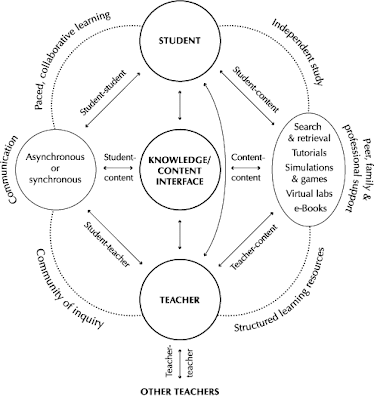
I've included this chart, which does a great job of visualizing the advantages of online learning.

Will people blur the lines between Virtual Reality and Reality?

One concern that I found most interesting was that of the effects of virtual reality and ethics. Beginning on page 107, Herbert Zettl discusses the implication of virtual reality and how human ethics may be changed. He discusses that our enjoyment of virtual reality is to avoid responsibility and also to act in ways we wouldn't normally act.
I believe these concerns are important and deserve attention however I wouldn't be too worried about the consequences of virtual reality games. The games which allow for killing, stealing, and other unethical acts are supposed to be ways for us to act with completely free will. However, if a friend of mine goes into a virtual game and kills someone, I'm not going to change my view of their ethics and morals. The separation between reality and virtual reality is strong enough that I believe it is not yet a concern for whether people will be able to distinguish the two. Maybe years down the road, as games continue to become more and more realistic and kids are raised with more and more capable technologies this concern may become more important. But I believe the barrier the still very strong between virtual reality and reality.

Tuesday, October 20, 2009

Tweeting Cyberspace

Try checking out what people are saying on twitter today about cyberspace:  http://twitter.com/#search?q=cyberspace

Cyberspace

This is a portrayal of how cyberspace may look like.

Six Degrees of Separation

I don't believe that if I sent a package to a guy in Mississippi, that through his friend of a friend of a friend of a friend of a friend, I would be able to get that package back. I think I'm going to try it. 
Networking on cyberspace has changed the way we socialize and make friends and is a great tool for accessing new types of information and personalities. 

Hyperlink

I thought it was interesting to make the connection between a hyperlink and "create your own story" books. A hyperlink is a convenient link, within text, which connects us to something else in the internet. The "create your own story" books are similar in that they give the reader options within the text to jump to another part of the story. I remember reading these books as a kid and think thats a great connection to the hyperlink technology we use today.

Neil Postman

I've had to read Postman for a few of my classes, and have always enjoyed what he has to say in regards to new media and technology. Enjoy!


http://www.youtube.com/watch?v=49rcVQ1vFAY


Cyberspace

Cyberspace is a really interesting phenomena that has come to be in the 21st century. It is a place where we all interact, but never actually have been. Whether it is through email, IM, text, phonecall, VR, etc, its a part of almost all modern communication (besides face to face contact).

Virtual reality, though it has slowed down in progress, has some really cool aspects to it. The army frequently creates simulators to imagine what iit would be like in battle. Drawing from this technology, consumers have been exposed to virtual reality through all sorts of different things. Disney world had this exhibit where you could ride a "virtual space mountain": (skip to about 1:30 for the video)


Medical Telepresence & Robotic surgery

The idea of telepresence is used today in many surgical procedures where hands could not possibly do the work that the robotic arm could. Small incisions and serious procedures are easily possible with this new technology.


Cyberspace

The idea of cyberspace, being this completely detached environment from reality seems at first crazy. But when you sit at the computer and search the internet you really understand what Gibson meant by cyberspace. As if behind the computer screen there is another world that exists. We realize it's not actually there, but we sense there is something more than just the computer. I think it's a mental phenomenon. The ability remove ourselves from our surroundings and invest our minds in this world outside of reality that really is nothing more than a computer screen, chips, wires, and information. Cyberspace is just a label for something we created and believe is there but really isn't.

Cyberspace: a virtual world


Spawning from the science of cybernetics (Norbert Wiener), cyberspace is a metaphor for describing the non-physical terrain created by computer systems. 


Tuesday, October 6, 2009

Digital and Analog

Digital describes electronic technology that generates, stores, and processes data in terms of two states: positive and non-positive. Digital technology is primarily used with new physical communications media, such as satellite and fiber optic transmission. A modem is used to convert the digital information in your computer to analog signals for your phone line and to convert analog phone signals to digital information for your computer.

Prior to digital technology, electronic transmission was limited to analog technology, which conveys data as electronic signals of varying frequency or amplitude that are added to carrier waves of a given frequency. Broadcast and phone transmission has conventionally used analog technology.

The most effective use of digital technology probably is cell phones. Due to the fact that new phone activations are increasing exponentially, the limits of analog are quickly being realized. Digital cellular lets significantly more people use their phones within a single coverage area. More data can be sent and received simultaneously by each phone user.

Privacy in the Digital World

According to techterms.com, Digital information is stored using a series of ones and zeros. Computers are digital machines because they can only read information as on or off -- 1 or 0. This method of computation, also known as the binary system, may seem rather simplistic, but can be used to represent incredible amounts of data. CDs and DVDs can be used to store and play back high-quality sound and video even though they consist entirely of ones and zeros.

Unlike computers, humans perceive information in analog. We capture auditory and visual signals as a continuous stream. Digital devices, on the other hand, estimate this information using ones and zeros. The rate of this estimation, called the "sampling rate," combined with how much information is included in each sample (the bit depth), determines how accurate the digital estimation is.

This video actually ends up being an ad for SafehouseExplorer but the concept of the video is really important. In this "digital age" our privacy is at an increased risk. Many of us have our whole lives on our computers, online, and on our cell phones; Our whole worlds saved into binary code. Websites track our use and save data, you lose a usb drive, you lose all of your personal information. Thanks digital world, where did our privacy go?!


Digital Information

The word digital when related to electronics is defined as: "Relating to or being a device that can generate, record, process, receive, transmit, or display information that is represented in discrete numerical form." (Thefreedictionary.com) The digital age in our world is fully upon us. That is to stay analog is being phased out. This past year the complete transition to digital television from analog was carried out. This was a process that took many years and a lot of work to see through. The simple reasons for the need for the switch is the endless possibilities that digital technology allows as compared with analog technology. For one, digital technology can handle and transmit much more information that analog. Also the digital technology allows for "on-demand" programming, where the user can choose the program he or she would like to watch, and it will play instantly. The digital age has and will continue to change our everyday lives.

The Digital World

According to the Free Dictionary website, digital, with respect to electronics, means relating to or being a device that can generate, record, process, receive, transmit, or display information that is represented in discrete numerical form. This is set in opposition to analog technology, which is a variable signal that is continuous in time and amplitude. Especially recently, the shift in television and radio in particular has gone towards the digital method, rather than the analog.

What's the Difference Between Analog and Digital?

Technology has come a long way since the the first analog recording by Thomas Edison. Now we live in a digital age with technology growing at a faster rate than ever. An analog signal is defined as a variable signal that is continuous in time and amplitude, as opposed to a digital or discrete signal. Music and the recording industry is one that has been greatly influenced by the birth of these recording technologies. So how do they work? In an analog technology, a wave is recorded or used in its original form. Analog signals are recorded directly onto the track and they maintain their natural shape.

This is a diagram of an analog wave:
One of the disadvantages to an analog signal is its susceptibility to be interfered with by noise. Because analog signals are not easily compressed, they are more likely to be warped by unwanted noise.

In digital technology, the analog wave is sampled at some interval, and then turned into numbers that are stored in a digital device. Computers do this by converting the signal into a strain of 1's and 0's. A cd player is an example of a digital technology, while an audio cassette player would be an example of an analog one.

Digital recording has many advantages over analog. Primarily, it produces a much warmer, richer, and more natural sound than analog recording. The reason for this is demonstrated in the following picture:
As one can see, because digital signals can be compressed and their waves can only reach a certain height, they are not very susceptible to interference from noise. As a result, the waves maintain their original form and are easily and accurately interpreted by a computer.

Digital vs. Analog in Recording and A Recent Digital Event

A way in which digital vs. analog has not been discussed yet is the difference betweeen digital recording and analog recording.  Analog recording is used in older mediums like cassette tapes and records. A key aspect of analog recording is that a physical property of the medium (like the groove on a record) is directly  related ( or analogous) to the properties (amplitude, frequency, etc.) to the original sound.An analog recording is related to the air pressure of the original sound. An analog signal is continuous in time.

 A digital recording is made by converting the properties of sound into a sequence of numbers. Usually the sound is transduced into an analog signal and then digitized using a converter. A digital signal is discrete in time.

On another note, I would like to talk about a recent event that involved digital vs. analog. This year the United States made the switch to digital cable, meaning only digital signals will be sent. This directly affected many people who did not have digital signals,  like digital cable. The government made available digital converter boxes for the switch. This is one example of how we are increasingly moving away from analog and embracing digital technology in media.

Digital Manipulation

The word 'digital' is a derivation of 'digit' and refers to systems which process numbers, typically 0’s and 1’s. Analog systems are a representation of an object that resembles the original, interns of waveforms. In a previous post, Lauren McCurdy included a simple distinction between analog and digital from wisegeek saying, “analog technologies record waveforms as they are, while digital technologies convert analog waveforms into sets of numbers, recording the numbers instead. When played back, the numbers are converted into a voltage stream that approximates the original analog wave.”

One of the most common comparisons made between digital and analog is with music recordings. At what point does a digital file cease to be a recording, and instead become a programmed performance in its own right? Lance Strate proposed this question in an earlier post and it speaks to a lot of controversy surrounding digital and analog forms of recording. Some musicians prefer analog recordings because the sound you hear is as close to being in the same room as the artist as possible without actually being there. However, modern recording artists tend to take full advantage of digital recording capabilities. Digital recordings can be converted, enhanced and manipulated on a computer to give you the final product. Take the newly popular “auto-tune” digital feature used by popular artists like Kanye West, and originally Cher in her song “Believe,” to produce a synthesized, digitally “perfect” vocal tone. Auto-tune uses a voice encoder to correct pitch in vocal and instrumental performances. It is used to disguise inaccuracies and mistakes, and has allowed many artists to produce more precisely tuned recordings (Wikipedia). Although the music we hear today on the radio is widely popular, could we actually call them “recordings?” What are the justifications between authentic audio content and an enhanced, auto-tuned “performance?”

There is no answer to this argument. Consumers in our modern society take tweaked and manipulated audio files to be forms of entertainment and have become widely popular. Digital technology has allowed for numerous advancements in music and the outcome of such is a subjective matter. Some will see it as taking away from the true talent that many musicians possess and others see it as the future and pure-genius.

Source: pcmag.com, techmind.org, wikipedia.org

Monday, October 5, 2009

Digital definition

The word digital comes from the Latin word digitus, meaning finger. Today, we associate the word digital with electronics, such as computers, televisions, cameras, and mp3 players as well as communication, such as radio and television. In discussing digital technology we also need to define analog technology. According to techterms.com, we as humans perceive information in analog, which means that we capture auditory and visual signals as a continuous stream. Digital devices, on the other hand, estimate this information using a binary system of ones and zeros. Unlike analog data, digital information can be copied, edited, and moved without losing any quality. Because of the benefits digital information offers, it has become the most common way of storing and reading data.  

According to Wikipedia, a digital system is a data technology that uses discrete (discontinuous) values. I think its interesting that by this definition, a written book can be considered a digital system due to the limited character set and the use of discrete symbols. We take digital to mean electronic devices; we do not normally think of a book as digital.

Digital Language & Communication

Digital has many definitions relating to different things. It relates to having digits, pertaining to a digit/finger, the use of data in numerial forms, and in computers or electronics "involving or using numerical digits expressed in a scale of notation to represent discretely all variables occurring in a problem" or "available in electronic form; readable and manipulable by computer" (Dictionary.com).
Any communication digitally requires some form of language, meaning "all the information that the sender and receiver of the digital communication must both possess, in advance, in order for the communication to be successful" (Wikipedia). "Languages are generally arbitrary and specify the meaning to be assigned to particular symbol sequences, the allowed range of values, methods to be used for synchronization, etc" (Wikipedia).
Just like any form of communication, language is necessary, and in the digital sense, language must be used, though differently, to be used by a computer or system. Not only are digital languages numbers, they are also digital representations of real language.
When I was trying to find more information about digital languages, I came across this website: digital dialects. Though it doesn't have a lot to do with what is written about, it shows how other digital representations are available.

DIGITAL

Digital refers to “the representation of information in binary form (ones and zeros), discontinuous in time.”

According to PCMAG digital “means perfect copies, the 0s and 1s of digital data mean more than just on and off. They mean perfect copying. When information, music, voice and video are turned into binary digital form, they can be electronically manipulated, preserved and regenerated perfectly at high speed. The millionth copy of a computer file is exactly the same as the original. While this continually drives the software and content publishers crazy protecting their copyrights, it is nevertheless a major advantage of digital processing.”

Nearly everything has become or is becoming digital. From digital video discs (DVD) to digital photography, we are surrounded by everything that is digital. We are drawn to everything digital because it brings many benefits for both consumers and firms. In addition, virtually everything is transitioning towards the internet and adapting to the rapidly changing world of media. According to techmind.org, “when compared to analog records or cassette tape, the CD has demonstrated greater dynamic range (which means no hiss during quiet parts of the music), very good and flat frequency response (so the sound is crisp), and the format is notably resilient to dust, dirt and scratches.” This is even more true for compressed MP3’s.

However, the digital world has not brought enthusiasm to everyone. Stephen Lacy, Professor at Michigan State University states that the “digital distribution of information has created concerns about the future of news organizations. Observers have speculated on how the Internet has and will change journalism, with almost as many different conclusions as there are speculators. These concerns have caused journalism educators around the country to reevaluate how they teach journalism.”

The future for digital technology is uncertain, but what is certain is that we will continue to accept, entrust and rely on digital technologies.

digital takeover?

According to Wisegeek.com, “The key difference between analog and digital technologies is that analog technologies record waveforms as they are, while digital technologies convert analog waveforms into sets of numbers, recording the numbers instead. When played back, the numbers are converted into a voltage stream that approximates the original analog wave.”

Although as a culture it seems like digital technologies are preferred at this point, we do have to give some credit to analog technologies. Without analog technologies, we (or our parents!) would not have been able to listen to the music that defined their generation. Analog technologies were used for vinyl records, 8-tracks, and even cassettes. In a way, I almost prefer analog technologies as a way to define a true artist. Although we have many great talents of our generation, digital technologies for CDs and MP3s help “clean up” tracks that artists create; they’re “digitally” remastered. Do you think this takes away from the artist’s credibility as a true talent, if their “talent” can be digitally restored and edited?

However, digital technologies sometimes rely on analog technologies to exist. For example, “when an analog waveform like music is recorded with a digital recorder, the music is sampled several thousand times per second. For a CD-quality recording, the average sampling rate is 44,000 times per second. That’s 44,000 numbers stored for each second of music. The higher the sampling rate, the more accurate the recording” (wisegeek.com).

Here’s a really interesting, real life example on the differences between analog and digital when it comes to artists recording and using modern technologies

http://www.youtube.com/watch?v=rrJBEmz5teA


I just have to wonder how much longer analog technologies will still be used in our world of digital media.

Sunday, October 4, 2009

DIGITAL VS ANALOG

Digital is relating to or being a device that can generate, record, process, receive, transmit, or display information that is represented in discrete numerical form.

As a technology, analog is the process of taking an audio or video signal (in most cases, the human voice) and translating it into electronic pulses. Digital on the other hand is breaking the signal into a binary format where the audio or video data is represented by a series of "1"s and "0"s. Simple enough when it's the device—analog or digital phone, fax, modem, or likewise—that does all the converting for you.

The newer of the two, digital technology breaks your voice (or television) signal into binary code—a series of 1s and 0s—transfers it to the other end where another device (phone, modem or TV) takes all the numbers and reassembles them into the original signal. The beauty of digital is that it knows what it should be when it reaches the end of the transmission. That way, it can correct any errors that may have occurred in the data transfer. What does all that mean to you? Clarity. In most cases, you'll get distortion-free conversations and clearer TV pictures.

The word DIGITAL describes any system based on discontinuous data or events. The important word here is discontinuous, which means not continuous or having breaks. The opposite of digital is analog.

ANALOG processes information more or less in a continuous stream. The difference can be easily seen in a clock. An analog clock is one with hands that move around the clock continuously producing a stream of time. Any minute and any fraction of a minute can be represented. For instance, you could look at an analog clock and say with some degree of accuracy that it is one and one half minutes past one o'clock. You could see that the minute hand was half way between one and two minutes. The average digital clock, which shows the time by flashing the hour and the minute, produces distinct minutes but cannot represent a half of a minute or a quarter of a minute. The digital clock will show that it is one minute past one or two minutes past one. You cannot tell from looking at the clock if it is one and one half minutes past one or one and a quarter minutes past one.

From the above description, you may surmise that analog is more detailed than digital, but that assumption would be incorrect. Although the normal digital clock will show only minutes, a more detailed digital clock could show fractions of minutes – even a thousandth or millionth of a second, something that an analog clock could not do as accurately. Digital equipment can accurately produce minute details. In addition, digital processing is important because a computer or other digital piece of equipment can store and manipulate digital signals quickly and easily. In addition, digital signals can be converted to analog signals to create a very high quality reproduction.


http://telecom.hellodirect.com/docs/Tutorials/AnalogVsDigital.1.051501.asp
www.dictionary.com
http://electronics.howstuffworks.com/question7.htm
http://www.cellphonecarriers.com/compare-digital-analog.html

Digital and Analog Technology

After refering to the website for telecommunications company, HelloDirect.com, the understanding I have of of analog and digital is as follows. Analog, a more simplistic form of technology is taking an audio or video signal and converting it into electronic impulses. Digital on the other hand is taking the audio and video signals and changing them to binary format. Examples of these technologies can be find in analog or digital phones, faxes, modems, or other machines that convert information for an individual.
Analog capabilities has been around for many decades, while digital is a newer ability. Among the disadvantages of analog are the limitations of the amount of data it can carry. Analog technology can only handle so much information at a time until it is overwhelmed. The new digital technology however, in breaking up sound and video and placing it into binary code, can carry more data. Disadvantages of digital are that since the technology is consistantly encoding and decoding, the quality of the end message isn't as clear as the analog version since it has been dismantled and put back together when recieved.
In today's world, we are consistantly hearing of new digital availabilities. Digital satellite television, or digital phones service. Having not really known what the big difference is, the way they make it sound in commercials is that digital is far superior to analog. And while it may be better, the disadvantage of bad quality is a concerning.

Friday, October 2, 2009

Digital vs. Analog

I went to a website run by Whatis.com to figure out what the difference between digital and analog is. They're 2 terms that I always hear in reference to cable tv, cell phone service, and music recording techniques, but I've never fully comprehended the difference between the 2. For me, digital is new and analog is old.

But! According to the website, digital is technology that transmits data in terms of positive or negative. These polarities are represented by a string of 1's and 0's, which goes back to the difference between bits and bytes. Each of these individual digits is a bit, but a string of them together used to convey information is a byte.

Analog is the older medium for processing information. Instead of the string of information conveyed in 1's and 0's, analog sends information by electric signals that have different frequencies and amplitudes.

Digital is the technology used in satellite communication, new cell phones, and fiber optics. The change over to strictly digital TV happened June 12th, but was supposed to happen much earlier. The government was handing out coupons in order to aid people who wanted to purchase a digital box. If a person used to use an antennae on top of his house to get tv, he would be using analog signals, while anyone watching FiOs tv is in the new era of digital technology.

Thursday, October 1, 2009

A Glance at Digital Divide

According to Frank E.X. Dance, a noted author in Communication and Cyberspace, there is such a thing as the digital divide in our culture. He notes:
"For some time now, cyberspace has been characterized as an electronic frontier, democratic and open to all, but such characterizations ignore the fact that only a minority of the population of the United States, let alone the world, is actually online."

He continues to argue that with digital access that the United States has they gain a, "monopoly of knowledge, and with it they gain unfair political, economic, and social advantages."He defines the digital divide as the gap between the expanding growth of digital users with computers and those who still lag behind in the paper world.

Another interesting viewpoint of Mr. Dance's is that, "when the remaining 96% of the world's population gets online we will have the true opportunity for building citizens of the world and a world citizenry."

How long do you think it will be before everyone is online? I should think that third world countries have a long way to go before they can afford to have personal computers for each citizen.

I have also included the Pro's and Con's of Digital and Analog as Wikipedia defines it:
Analog-Analog systems are very tolerant to noise, make good use of bandwidth, and are easy to manipulate mathematically. However, analog signals require hardware receivers and transmitters that are designed to perfectly fit the particular transmission. If you are working on a new system, and you decide to change your analog signal, you need to completely change your transmitters and receivers.
Digital-Digital signals are intolerant to noise, and digital signals can be completely corrupted in the presence of excess noise. In digital signals, noise could cause a 1 to be interpreted as a 0 and vice versa, which makes the received data different than the original data. Imagine if the army transmitted a position coordinate to a missile digitally, and a single bit was received in error? This single bit error could cause a missile to miss its target by miles. Luckily, there are systems in place to prevent this sort of scenario, such as checksums and CRCs, which tell the receiver when a bit has been corrupted and ask the transmitter to resend the data. The primary benefit of digital signals is that they can be handled by simple, standardized receivers and transmitters, and the signal can be then dealt with in software (which is comparatively cheap to change).